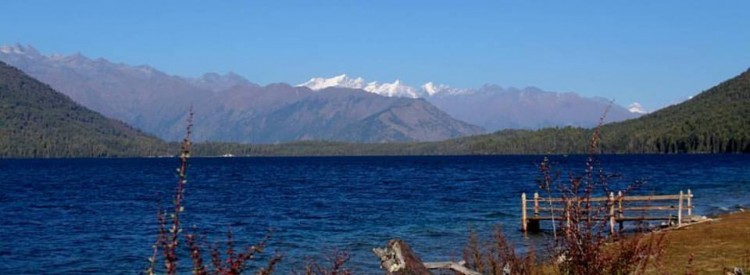
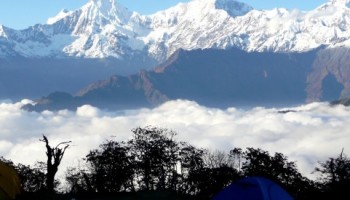
Rara Lake (Queen of Lakes) trekking sweeps the remote trekking destination of Mugu district which encounters magnificent Rara Lake at a height of around 3,000 m holding 167 m of depth, 5.1 km length, and 2.7 km width with high surrounded towering mountains throughout.
Rara Lake trekking for 15 Days begins with a scenic flight to Nepalgunj and then to Jumla (the Highest rice-growing portion in Nepal). Forward marching foot starts by carrying a dream to step Rara Lake bypassing multiple bridges, numerous attractive settlements, and countless forests en route. Finally stepping on the biggest and deepest lake of freshwater (Rara Lake) with a few varieties of fish along towering mountains by the side makes you feel like encountering the great achievement of trekking. The entrance of Rara National Park (considered the finest park in Nepal) holding musk deer, Himalayan black beer, Himalayan Goral, and many other exotic florae and faunas along crossing multiple high passes makes trekking more stunning and rewarding. Spending overnight in a teahouse while trekking is rarely included in very few trekking destinations so this unique experience included in this package makes it more attractive and rewarding.
Day 3: Fly from Kathmandu (1,300) to Nepalgunj (165 m)
Day 4: Fly from Nepalgunj (165 m) to Jumla (2,540 m)
Day 5: Trek form Jumla (2,540 m) to Chere Chaur (3,055 m)
Day 6: Trek from Chere Chaur (3,055 m) to Chala Chaur (2,980 m)
Day 7: Trek from Chala Chaur (2,980 m) to Sinja Valley (2,490 m)
Day 8: Trek from Sinja Valley (2,490 m) to Gorusingha (3,050 m)
Day 9: Trek from Gorusingha (3,050 m) to Rara Lake (3,010 m)
Day 10: Rara Lake (3,010 m) – (Exploration and Acclimatization day)
Day 11: Trek from Rara Lake (3,010 m) to Pina (2,440 m)
Day 12: Trek from Pina (2,440 m) to Bumra (2,850 m)
Day 13: Trek from Bumra (2,850 m) to Jumla (2,540 m)
Day 14: Fly from Jumla (2,540 m) to Nepalgunj (165 m) and then Kathmandu (1,300 m)
Day 15: Departure day
Cost Includes:
Airport pickups and drops in a private vehicle
3-star hotel accommodation in Kathmandu and Pokhara with breakfast
Teahouse accommodation during the trek
All meals (breakfast, lunch, and dinner) during the trek
Farewell dinner in Kathmandu
All ground transportation on a comfortable private vehicle as per the itinerary
Domestic flight (Jomsom-Pokhara)
Guided city tour in Kathmandu by private vehicle
Entrance fees for sightseeing/monument visits as per the itinerary
An experienced, English-speaking, and government-licensed trek leader and assistant trek leader (4 trekkers: 1 assistant guide)
Porter service (2 trekkers: 1 porter)
Staff costs including their salary, insurance, equipment, domestic airfare, food, and accommodation
Down jacket and sleeping bag (to be returned after trip completion)
All necessary paperwork and trekking permits (National Park Permit, TIMS)
Medical kit (carried by your trek leader)
All government and local taxes
Cost Excludes:
Nepalese visa fee
Excess baggage charge(s)
Extra night accommodation in Kathmandu and Pokhara because of early arrival, late departure, or earlyreturn from the mountain due to any reason other than the scheduled itinerary
Lunch and evening meals in Kathmandu
International flights
Travel and rescue insurance
Personal expenses (phone calls, laundry, bar bills, battery recharge, extra porters, bottle or boiled water, shower, etc.)
Tips for guide(s), porter(s) and driver(s)
* This tour can be fully customized as per your requirement.
Day 1: Arrival day in Kathmandu (1,300 m)
Following your arrival schedule at Tribhuwan International Airport (Kathmandu), our company representatives await your warm welcome and for shifting towards a luxury tourist standard hotel. Initially, we notice gathering at our office for an ordinary discussion about the upcoming trek.
Day 2: Kathmandu sightseeing and trek preparation
After attending light breakfast, we steadily step ahead by planning to sightsee some attractive spots including Pashupatinath Temple, Swyambhunath Stupa (monkey temple), and Boudhanath Stupa which can occupy its space on the list of UNESCO World Heritage Sites. Soon, after monitoring these amazing sites for some moments, we return for finalizing the trekking requirements that are essential for our upcoming trek. This second night will also be spent at the same hotel in Kathmandu.
Day 3: Fly from Kathmandu (1,300) to Nepalgunj (165 m)
Early morning after having breakfast, our private vehicle shifts us to the airport to catch a flight towards Nepalgunj. However, after an hour of scenic flight lands at Nepalgunj airport and further, and we will be transferred to a nearby fine standard hotel. The remaining time of the day will be spent inspecting the mini zoo, and Muslim Bazaar and exploring unique Tharu villages throughout. Initially returning to the hotel in the evening hour night will be spent at a lodge in Nepalgunj.
Day 4: Fly from Nepalgunj (165 m) to Jumla (2,540 m)
Today soon after consuming a unique item of breakfast according to your choice, we will be transferred to Nepalgunj airport to catch a short takeoff flight towards (SLOT) airport to Jumla. Finally, after landing our flight on Jumla, the remaining hours will be spent exploring the territory along with finalizing the bag packs and arrangements for the next walking day. This night will be spent at a tea house in Jumla.
Day 5: Trek form Jumla (2,540 m) to Chere Chaur (3,055 m)
On the fifth day after breakfast, we develop our exciting walk ahead following the northern part of the town by climbing up the Jugad valley along passing Khalang bazaar behind. Marching ahead bypassing numerous villages with traditional houses and temples leads toward Sisnamul along crossing forest and meadows takes to a high altitude meadow to step Chere Chaur. Evening hours will be spent by inspecting nearby domains and night will be spent at a tea house in Chere Chaur.
Day 6: Trek from Chere Chaur (3,055 m) to Chala Chaur (2,980 m)
Leaving Chere Chaur behind early morning after breakfast, we follow the western trail and hike up to Jaljila Pass located at the height of (2,980 m). Steadily encountering the pass and continuing our walk forward through the plain trail leads towards Jaljala Chaur along crossing a steep trail with Syaule River takes to Chala Chaur. Leisure hours of the evening time will be spent exploring throughout and the night will be spent at a tea house in Chala Chaur.
Day 7: Trek from Chala Chaur (2,980 m) to Sinja Valley (2,490 m)
Today after breakfast at Chala Chaur, we move our step ahead following the walking path on the side of the Jaljala River. Walking continuously forward bypassing numerous mini settlements, paddy fields, and stone temples with many other attractions en route leads towards Sinja Valley situated at the bank of the river. Finally, after steeping valley, we spent our remaining hours exploring beauty throughout and the night will be spent at a tea house there.
Day 8: Trek from Sinja Valley (2,490 m) to Gorusingha (3,050 m)
After breakfast at Sinja, we develop or trek leaving the valley near the bank of the river by following the east trail along the Hima River towards Laha. Initially, now changing direction from Laha towards the west alongside another river finally takes to Gorusingha which is also spotted at the bank of the river. An army post that looks like a Hollywood ranch arrives at Gorusingha and the night will be spent at a tea house in Gorusingha.
Day 9: Trek from Gorusingha (3,050 m) to Rara Lake (3,010 m)
Attending breakfast early morning, an initially steady walk ascends towards the high spot of Chuchamare Danda for inspecting a beautiful view of the panorama with the western Himalayas, Rara Lake, and the National Park too. Ahead of the walking trail leads towards the meadows on the ridge for steeping Majhghat by crossing a pleasing forest and a stream along a continuous walk forward takes to Rara Lake passing numerous settlements and a National park en route. This night will be spent at a tea house in Rara.
Day 10: Rara Lake (3,010 m) Exploration and Acclimatization day
Finally, after stepping on the high rewarding destination, we stop our adding additional steps forward for a day focusing on both exploration and acclimatization. So, after breakfast, we don’t add elevations on our trek but we plan to monitor throughout eye-catching Rara Lake therefore a couple of hours will be spent enjoying boating around the lake encountered by a few varieties of fishes. After that, we hike up to Murma top for inspecting stunning views of lakes surrounded by towering mountains. Returning, today’s night will be spent at the same location where we had spent the earlier day.
Day 11: Trek from Rara Lake (3,010 m) to Pina (2,440 m)
After a day of exploration and acclimatization, today’s walk begins after breakfast with a steady and easy walk through a straight path to Ghamgadi (Headquarters of Mugu District). Therefore, the trail descends passing Rhododendron, Pine, Oak, and Juniper forests to Jhyari Khola along a short uphill walk and then a level path march through the next pine forest finally takes to Pina. Tonight’s accommodation and dinner will be managed at a tea house in Pina.
Day 12: Trek from Pina (2,440 m) to Bumra (2,850 m)
Today after having breakfast in Pina, we walk forward through a circuit trail bypassing spruce forest up to the Ghuruchi Lagna Pass which greets us with fluttering prayer flags with towering snow-capped peaks bordering Tibet and Nepal and the view of Karnali River as an addition. After spending some moments, we directly walk down to Bhulbhule along then to Burma passing terraced fields and a few mini settlements and finally, this night will be spent at a tea house in Burma.
Day 13: Trek from Bumra (2,850 m) to Jumla (2,540 m)
Last day of the walk, we develop early morning steps after having breakfast in Burma. Firstly, we hike up to the suspension bridge at an altitude of 3,680 m along crossing the bridge we march forward to cross the next bridge and continue to walk downhill through the forest of Fir, Walnuts, and bamboo taking us to Himdhuski. Therefore, the gradually rising trail leads us toward Daphe Lagna Pass crossing numerous attractive settlements. Finally, after inspecting throughout trail descends to Jumla for spending overnight in the tea house.
Day 14: Fly from Jumla (2,540 m) to Nepalgunj (165 m) and then Kathmandu (1,300 m)
After attending host breakfast in Jumla, the day starts with a morning scenic flight over the Himalayas to Nepalgunj, and initially after landing at Nepalgunj Airport, we catch our booked flight to Tribhuwan International Airport (Kathmandu). On reaching Kathmandu, our private vehicle escorts you towards a fine tourist standard hotel, and evening time will be managed for a farewell dinner along the night will be spent at the lodge.
Day 15: Departure day
Last day paying attention to your flight time, you can go for shopping to collect gifts for friends or family members. We will be there for helping you with your necessary arrangements and packing if you need our private vehicle will be there to shift you to the airport focusing on departure hours. Our well-wishers and representatives will be there to wish you a safe journey and successful steps ahead of your last time in Nepal.
Please Check Available Dates for The Year of:
Start Date
End Date
Availability
Price
Booking
Visa Information
All visitors are required to arrange a visa to enter Nepal. A Nepalese visa can be easily obtained upon arrival on arrival in Kathmandu at the airport or the Nepalese embassy abroad. But nationals from Afghanistan, Iraq, Cameroon, Ghana, Somalia, Swaziland, Palestine, Zimbabwe, Nigeria, Ethiopia, and Liberia cannot secure the Nepalese Visa upon arrival. The Visa can also be secured at the entry points at Nepalese borders. A valid passport for at least six months, a recent digital photo (size: 1.5" x 1.5") will be required and you can obtain visas for Nepal from the Nepalese Consulate in your country or upon arrival at Kathmandu Airport. Nepalese visas cost USD 25 for 15 days and USD 40 for 30 days to date.
Official Papers
Some of the required official documents are your valid passport, 4 extra passport-sized photographs (for trekking permits), travel insurance, airline tickets, and luggage tags. Visas can be obtained upon entry into Nepal.
Weather Information
The weather in the mountains is pretty difficult to predict. Nights are generally cooler and days are warm. The months of winter (January and February) are a bit colder but the days can be quite beautiful and warm if the sun is out. It snows during January, February, and December in the Himalayan areas.
Best time to travel
Nepal offers diversified geographical regions and so the climatic condition differs from the Himalayas to the plains. The climate varies as per the season. Nepal generally offers 4 seasons amongst which autumn and spring are the two most favorable ones for visiting Nepal. It is always wise to know about the weather and climatic condition of the place you visit. The best time to travel depends on your destination, activities, and season of travel. Our destination specialists will recommend certain travel times after learning more about your preferences. The favorable months for trekking and climbing are usually September – November, and February – April. The monsoon season is June – August.
Physical Fitness
Even though physical fitness plays an important role in trekking you don’t have to be a super athlete or a marathon runner to trek in Nepal. Many people of good fitness for their age can complete the trek. You can prepare yourself beforehand by doing some yoga which will prepare you for your breathing as you will be going to a higher altitude. Running or hiking on hills, or going for a long walk will also help you. And if you live in an urban area running down the stairs of a tall building will also work better in keeping you fit for trekking. Though these preparations aren’t strictly compulsory, you can do well even when the preparations you do aren’t rigorous like that of some ultra-athletic person. Do these things at a moderate pace for two months or even less? And you are set to complete any trekking to Nepal.
Travel Insurance
Doing insurance while trekking in Nepal is not compulsory but will surely help you a lot if you do one, as it covers any comprehensive expenses possible to acquire due to medical issues or accidents. Your travel insurance must protect air ambulance, treatment charges, rescue and evacuation, product cancellation and refundable charges, flight delays, and cancellations. We suggest you bring your travel insurance certificate or send us to scan copy and it must be issued from your homeland. We do not arrange or sell insurance so you can find your local travel insurance for this.
Vaccination for Nepal
All travelers should consult with their physician or update on vaccination requirements before travel. (Your doctor or health-care provider will determine what you will need, depending on factors such as your health and immunization history, areas of the country you will be visiting, and planned activities) For traveling to Nepal; we recommend you take vaccination for Polio, Tetanus, Typhoid, Hepatitis A, Hepatitis B, Rabies, etc, it is not really must but recommended.
Booking Process
While you chose which trip you wanted to go with, contact us at our head office, Thamel Marg, Kathmandu Nepal by email or phone, email is a more easy and clear option, as soon as we get your email or call, we will process your booking. We need a 20% booking amount to confirm your booking, the payment can be made through Bank transfer, Credit card payment (Master/Visa card), or online money transfers also Money Gram, Western Unions, or others. After we get the 20% amount, we will confirm your booking and you will get the official booking and payment receipt. The final balance for the tour will be paid upon arrival in Kathmandu.
Safety Guidelines
Do proper research about the company that you are planning to trek with and make sure they are a legally registered travel agency.
You should be well acquainted with travel health and travel insurance before traveling.
Have an idea about the climate, geography, temperature, and environment of Nepal before starting your trip.
Using credit cards instead of cash is a wiser idea.
The majority of the Nepalese people are nicer but there are a few scammers you will come meet on your way and need to avoid, for example, ‘holy men’ who will try to plant a tika (a red paste denoting a blessing) on your forehead demanding payment for it on streets.
Be careful while buying the medicinal herbs as some may be illegal for you to take home and also be aware of duplicate products.
Never get involved in doing drugs, trafficking, and sexual relations with minors as there are strict rules for these cases, and might get you into a big problem.
Take copies of your passport, visa, air ticket, and trekking permits and keep them separately from the originals.
Prepare yourself for altitude sickness and be familiar with its symptoms so that you can follow the guidelines for safe acclimatization.